If you want to know when Jesus will return, the most precise eschatological clock exists within the Hebrew calendar.
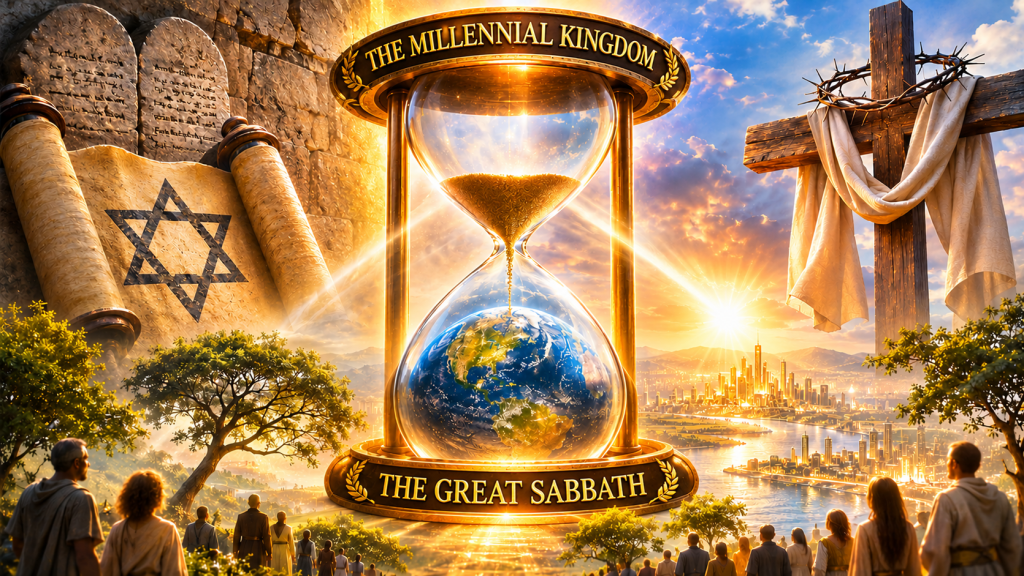
According to well-known scriptural interpretations, human history operates on a seven-thousand-year framework, with each millennium equating to one day of a seven-day week.1 The Hebrew sages explicitly map this out, declaring that the first six thousand years of human history, analogous to the first six days of the week of creation, will be characterised by toil and strife, followed by one thousand years of peace and restoration, analogous to the Sabbath day of rest.2
This Great Sabbath corresponds with the thousand-year reign of Christ described in Christian eschatology, likewise heralding an age of universal peace, righteousness and restoration following His return.3
Right now on the Hebrew calendar, we are living in the year 5787. (Therefore, as each millennium equates to one day of the week, with the first day being Sunday and the last day being Saturday, that means that, figuratively speaking, we’re now living in the equivalent of Friday evening over the seven-thousand-year span. Not a bad time to be alive!)
Counting forward to the beginning of the Great Sabbath, from the time of writing this article, we are exactly 212 years and 316 days from the beginning of the final millennium, due in mid-September 2239 CE.
But before we pull out the party poppers in preparation for that date, we have to confront a rather unsettling question. Not “When will he come?” but “Who will he really be?”
The Eschatological Mirror: Messiah or Antichrist?
When you place Jewish and Christian eschatology side by side, a mirror image emerges. Both traditions are watching for the exact same set of geopolitical events to unfold on the world stage, yet they assign opposite names to the man who accomplishes them.
In Jewish tradition,4 the Mashiach (Messiah) is a human leader who proves his prophetic identity through tangible, real-world accomplishments:
- He ends war and establishes global peace: Nations destroy their weapons of war and follow his lead.5
- He eliminates famine and economic turmoil: Hunger disappears, abundance becomes universal, and humanity is freed from material scarcity.6
- He purges idolatry from the earth: False religious systems and physical objects of worship are dismantled.7
- He rebuilds the temple in Jerusalem: True worship of God is restored.8
Now look at those exact same events through the Christian eschatological lens. From this point of view, when an ordinary human leader steps onto the world stage to accomplish this exact same checklist, he’s labelled the Antichrist:
- He brokers global peace: Nations lay down their arms and enter an international peace covenant.9
- He brings economic stability and abundance: Material crisis gives way to widespread peace and safety.10
- He overturns old shrines and establishes religious authority: Existing objects of worship are dismantled as he takes his seat in the temple.11
- He rebuilds the temple in Jerusalem: The temple is restored and offerings resume.12
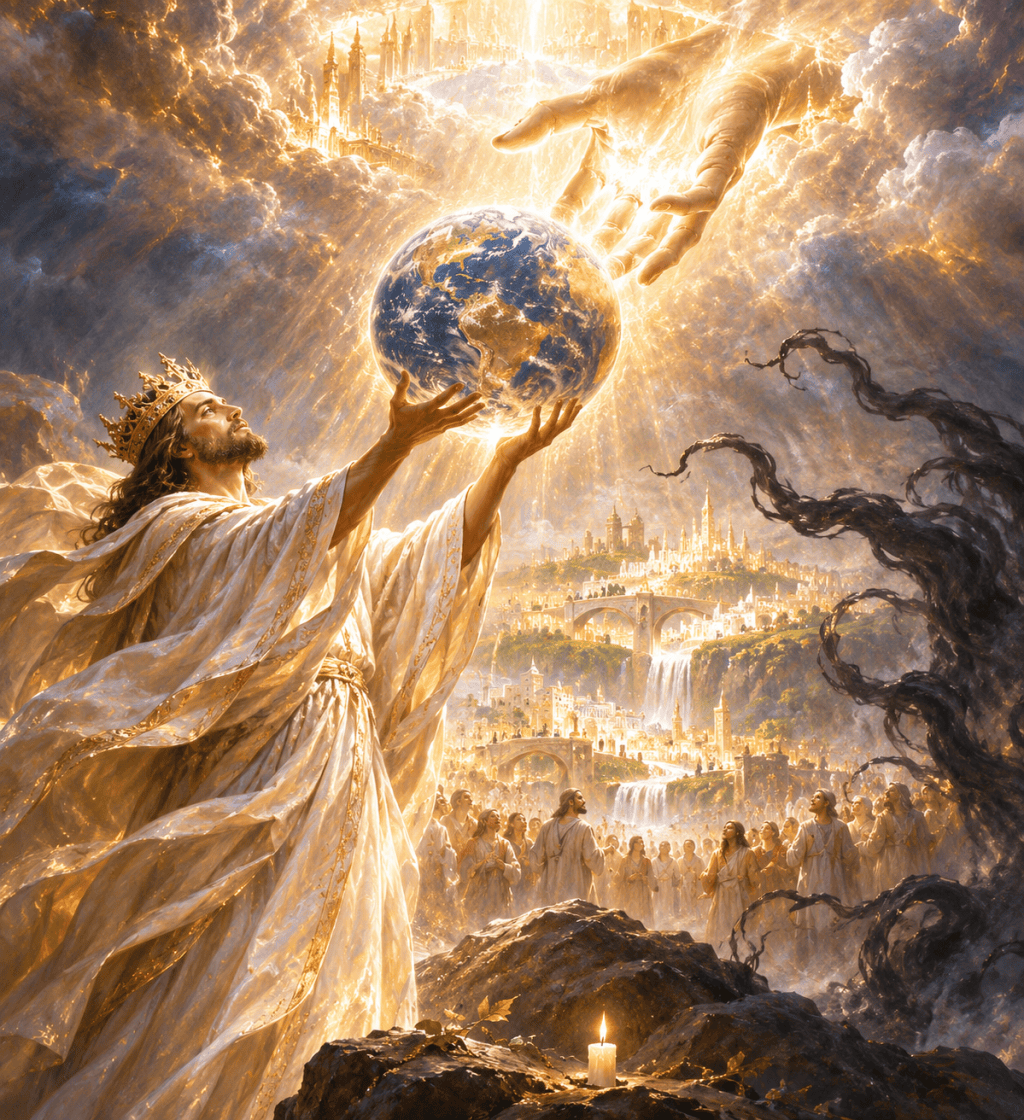
The catch is that in Christian eschatology, these achievements are only short-lived, lasting only a few years before coming undone. The true Messiah only arrives afterward, descending from the sky as a fully supernatural, radiant, God-like being to overthrow this earthly leader and establish a permanent kingdom.
Interestingly, Jewish tradition contains a parallel clause: before the final Messiah, Mashiach ben David, arrives, a precursor figure known as Mashiach ben Yosef steps onto the stage, whose accomplishments are cut short before completing the full checklist.13 Both traditions agree that a short-lived peace doesn’t mark the final Messiah. The difference is that Judaism views him as a well-meaning forerunner, while Christianity condemns him as the inherently malevolent Antichrist.
Despite these parallel clauses, however, one irreconcilable divide still stands out: Christianity demands a supernatural, heavenly, God-like being bearing the wounds of the crucifixion, while Judaism demands an ordinary, mortal human being who looks fundamentally like any other.
The Theological Complications
Examining the expectations of either side closely, neither tradition is free from its own internal contradictions.
Christianity demands a supernatural spectacle. Jesus is expected to arrive descending from the clouds in a transfigured, radiant body bearing the visible marks of stigmata: the nail wounds in his hands and feet, and the spear wound in his side.14 Any normal, mortal human being who walks the earth and fulfils the prophecies is automatically ruled out as a malevolent deceiver and false Christ.
Yet this creates a glaring double standard inside Christianity’s own teachings. Christians flag that the Antichrist will deceive the world with “all kinds of miracles, false signs, and wonders”,15 while simultaneously insisting they’ll only trust a miraculous, superhuman figure descending from the sky. On the one hand, miraculous occurrences are proof of the Antichrist; on the other, they refuse to trust anyone who can’t perform them.
The Jewish understanding contains an equal and opposite contradiction of its own. Judaism strictly insists that Mashiach is an ordinary human being, yet its own scriptures and Talmudic commentary16 allow for two distinct versions of him: if humanity is unworthy, the Messiah arrives humbly, riding into Jerusalem on a donkey.17 This prophecy has already been fulfilled by Jesus, the saviour of an unworthy humanity in need of redemption. That leaves only the second option: if humanity is worthy, the Messiah arrives gloriously, “with the clouds of heaven”.18 Yet anyone descending gloriously from the clouds of heaven is clearly not an ordinary human being.
These are the eschatologies as they stand, locked in a stalemate and tangled in their own internal knots. So where do we go from here?
Stepping Out of the Binary and Into the Greater Truth
To make sense of this stalemate, you have to step out of 3-dimensional, either/or thinking and into 4-dimensional, both/and thinking, where apparent contradictions can be transcended into a unified, holistic truth that holds both sides together without cancelling each other out.
In my previous article, “The Binary to End All Binaries,” I demonstrated how two people standing on opposite sides of a room can look at the same figure painted on the floor, where one sees a “6” with absolute certainty, and the other sees a “9” with equal certainty. Neither is lying, neither is wrong, yet neither is cognisant of the whole truth, which is discernible from a ‘higher’ vantage point.
There’s a world of difference between prophecies as they’re written on paper and the way things unfold in reality. Reality isn’t played out on paper, the way eschatological arguments often are. And it’s in the real world that the weaknesses of either tradition, taken in isolation, become apparent.
Christianity insists on the Messiah’s divinity, but in so doing, strips him of his humanity. By placing Jesus on a supernatural pedestal removed from ordinary experience, Christian dogma turns humanity’s divine potential into a threat. Those who speak of the sacred spark inherent in every human being, and our capacity to accomplish extraordinary things, are branded as arrogant, deceived, or aligned with the Antichrist. Thus, a doctrine whose purpose is to proclaim humanity’s salvation becomes weaponized into an instrument of fear, shame, accusation and ostracism.
Jewish doctrine makes the opposite mistake. By insisting on a strictly mortal, human Messiah devoid of any supernatural, universal, or transcendent elements, it becomes overly insular, divisive, and exclusionary, reducing God’s influence on Earth to the private inheritance of a single people rather than a universal awakening for all humanity.
To make the effect of these doctrines clear in the way they actually manifest themselves in society, take an example from chemistry.
Pure sodium is an unstable metal that bursts into flame on contact with water. And pure chlorine is a toxic gas that suffocates life. Alone, neither is safe. Yet when combined, they neutralise each other’s dangers and form sodium chloride, ordinary salt, the essential preservative that sustains human life.
Jewish and Christian eschatology and dogma work the same way. Judaism, like sodium, brings grounded human realism without universal reach. And Christianity, like chlorine, brings universal reach tangled in unresolved contradictions. When you bond them together, moving from two isolated, reactive elements into a higher, unified compound, the danger dissolves, and you get something that preserves and elevates everything else in life.
The Final Verdict
This brings us back to our cosmic, eschatological, seven-thousand-year clock.
Whether the seventh millennium unfolds as a supernatural reign,19 an unbroken human dynasty ushering in a golden age, or a fourth-dimensional awakening that binds human and divine truth into a unified whole, the 1,000-year Millennial Kingdom and the Great Sabbath beginning in the Hebrew calendar year 6000 are the same, overlapping event.
So here’s the fair and reasonable verdict. Skeptics who reject all forms of religion, spirituality, God and eschatology should, in all fairness, at least wait another 212 years and 316 days until the Hebrew year 6000 (September 2239) before rubber-stamping it as conclusively false.
On the other hand, being generous and giving a buffer of 100 years, if we reach the Gregorian calendar year 2339 and there’s still no end to war, no global restoration, and no peace, then the knives can, in all fairness, come out, and both traditions will have to confront the fact that, by their own devices, their time has run out.
Until then, wisdom lies in keeping our minds open. In recognising that when reality finally arrives, it will in all likelihood be more interesting, strange, human and divine than either side predicted on paper.
- Psalm 90:4; 2 Peter 3:8 ↩︎
- Sanhedrin 97a; Avodah Zarah 9a ↩︎
- Revelation 20:4–6 ↩︎
- Mishneh Torah, Laws of Kings and Wars, Chapters 11–12 ↩︎
- Isaiah 2:4; Micah 4:3 ↩︎
- Mishneh Torah 12:5 ↩︎
- Isaiah 2:18; Zechariah 13:2 ↩︎
- Ezekiel 37:26–28 ↩︎
- Daniel 8:25; 9:27 ↩︎
- 1 Thessalonians 5:3 ↩︎
- 2 Thessalonians 2:4 ↩︎
- Daniel 9:27; Matthew 24:15 ↩︎
- Sukkah 52a; Mishneh Torah 11:4 ↩︎
- Zechariah 12:10; Revelation 1:7 ↩︎
- 2 Thessalonians 2:9 ↩︎
- Sanhedrin 98a ↩︎
- Zechariah 9:9 ↩︎
- Daniel 7:13 ↩︎
- Revelation 20:4 ↩︎