
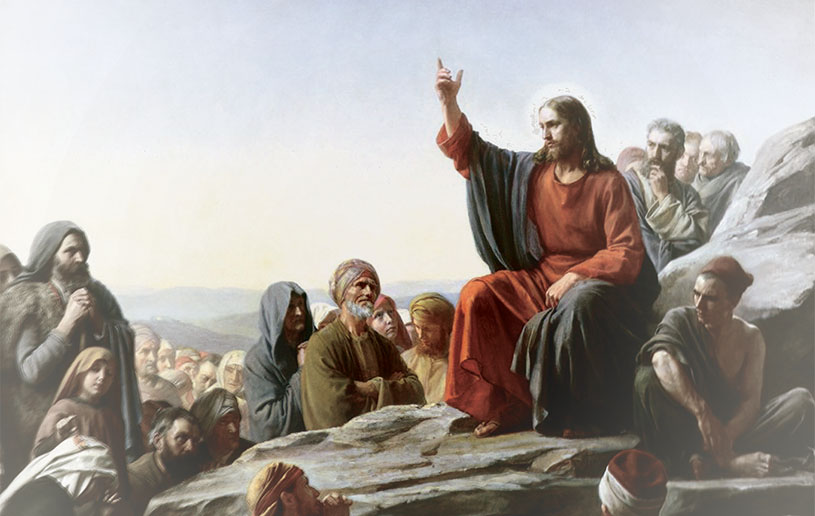
Behind the familiar creeds lies a mystery that refuses to be reduced to formula — the eternal Logos clothed in flesh.
The Church affirms that Jesus is fully human. Yet that affirmation tends to stay on the surface, while His divinity is given the weight of glory. Out of reverence we want to guard His place in the Trinity, His glory as God the Son. But in our zeal, we often forget that the glory of God was revealed in the body of a man.
It wasn’t beneath God to sweat, to hunger, to laugh, to bleed. It wasn’t beneath Him to grow in wisdom, or to learn new things. Scripture tells us these truths: “He emptied himself, taking on the form of a servant, being born in the likeness of man” (Philippians 2:7). “Jesus grew in wisdom, and in stature, and in favor with God and man” (Luke 2:52). The Son of God lived as a human being, from the inside out.
More Than a Doctrine
Dogma presents His humanity in the dry language of theology: “Fully God and fully man.” It’s been repeated so often that the words sound empty, when in fact they should blaze with revelation. When you pause and let it sink in, the fact that the Creator walked as a man among us should leave us feeling inspired.
He knew exhaustion after a long day’s journey. He felt the ache of loneliness. He grieved. He rejoiced in children’s laughter. He bore the sting of rejection. His divinity was poured into a human vessel that felt, ached, learned and grew.
God didn’t lose one bit of His glory by becoming human. Instead, humanity was transfigured by his presence.
What it Means to be Fully Human
Humanity is often thought of in terms of weakness — our appetites, our mortality, our vulnerability. But to be human is to carry glory. “You have made man a little lower than the heavenly beings and crowned him with glory and honor” (Psalm 8:5). To be human is to bear the image of God.
That Jesus was fully human means he lived the full range of what human life entails. He learned to speak a language as a child. He practiced a trade growing up. He experienced friendship, love and betrayal. He understood what it meant to have a family. He feasted and fasted. He slept and dreamed.
Because Jesus was fully human, his victory reached all the way into flesh and blood. Sin was condemned not in theory but in a body, so that freedom from sin can now flow into ours. We are not doomed to cling to shadows; the power of sin no longer holds us. Through him, freedom runs in our very blood.
The Revelation of His Humanity
For many, the divinity of Jesus is the astonishing part. But his humanity should astonish us just as much. Theologians sometimes say He “condescended” to be human. But in truth, He dignified humanity. He revealed what it was always meant to be.
And here is where the revelation becomes personal: if Jesus’ body could be the dwelling place of God, then so can ours. Not in all its fullness — He is the template for the rest of us. But He came so that what was true in him might begin to be true in us.
The Logos in Us
The Gospel of John calls Him the Logos — the Word through whom all things were made. “In the beginning was the Word, and the Word was with God, and the Word was God” (John 1:1). And this Logos “became flesh and dwelt among us” (John 1:14).
But here is the gift: Logos is not absent from us, either. Every human being has the spark of reason, conscience, imagination, and creativity. It’s what lifts us above the animals. It’s what makes us capable of communion with God.
To walk in our logos is to touch the life of Christ. And to walk in Christ is to awaken the logos within us. They are not rivals but threads of the same tapestry. This is what He meant when he said, “I am the way, the truth, and the life. No one comes to the Father except through me” (John 14:6) — every true step into logos is a step through Him.
Jesus’ humanity is not only something we look at from afar. It’s something we participate in. When He became man, he didn’t just show us what God is like. He showed us what humans are meant to be.
The Living Tree
Jesus was human in every sense, yet He is also the living Tree, whose roots run into eternity and whose branches stretch across every age. In Him, God and man are grafted together as one living organism. To affirm him is not to limit Him, but to stand amidst His branches and let His life flow through us.
This is it: a Tree with roots in eternity, branches spanning history, its sap flowing through our veins. That’s what it means for Jesus to be both God and human. His humanity isn’t a footnote to His divinity. It’s the soil in which divinity was planted, so that the tree of life could rise again in our midst.
Heirs Through Humanity
The story of Jesus humanity doesn’t end with him. It extends to us. Paul says it: “When the time had fully come, God sent His Son, born of a woman, born under law, to redeem those under law, that we might receive the full rights of sons” (Galatians 4:4-5).
Because he was born in the world as a human being, we are left not as servants, but as sons and daughters, heirs to His kingdom.
This is why it matters to hold fast to his humanity. Not because it threatens His deity, but because it secures our inheritance. If he wasn’t fully human, we can’t be fully redeemed. If he wasn’t one of us, we can’t be made one with Him.
Conclusion
To see Jesus as a human being is not to shrink him, but to see Him more clearly. To imagine him laughing, sweating, learning, hurting, and loving is not to reduce Him, but to worship him more fully.
The dogma has its place. It points towards truth, but isn’t the truth itself, which is greater. Let’s not let it shrink the wonder. Jesus was God. Jesus was human. And in that union, heaven and earth meet, and God and humankind are reconciled.
If His divinity reveals the face of God, his humanity reveals the fate of man. And together, they reveal the living Christ, who is with us now.
———————————
*In this piece, I use “his” (lowercase) to speak of Jesus’ humanity, and “His” (uppercase) to speak of His divinity. This is intentional, to honor both natures without letting one eclipse the other.
